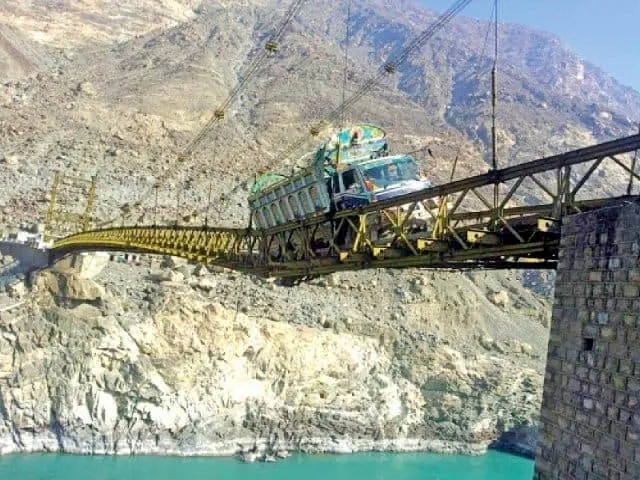
Bridges are more than just engineering marvels; they are lifelines that connect cities, villages, and even entire nations. Yet, some bridges around the globe test the limits of human courage, engineering resilience, and natural endurance.
From the icy wilderness of Siberia’s Kuandinsky Bridge to the bamboo-built Monkey Bridges of Vietnam, these precarious crossings are as fascinating as they are frightening.
Suspended over raging rivers, deep valleys, and glacier-fed lakes, the world’s most dangerous bridges blend history, culture, and extreme risk, attracting both locals who depend on them for survival and thrill-seekers chasing adrenaline.
Here are the top most Dangerous Bridges in the World:
20. Quepos Bridge, Costa Rica
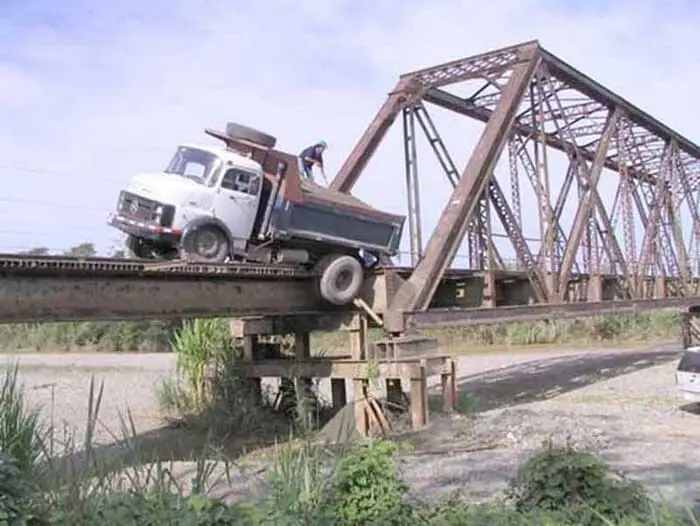
The Quepos Bridge, infamously known as the “Bridge of Death” or “Oh My God Bridge,” is widely regarded as one of the most dangerous bridges in the world, located on the route connecting Jacó to Quepos in Costa Rica’s Central Pacific region.
Originally built in the 1930s–1940s by the United Fruit Company for transporting bananas, the bridge remains a relic of industrial history.
Its narrow, single-lane design allows only one-way traffic, forcing vehicles to cross with extreme caution.
Constructed from wooden planks, the bridge appears fragile, yet it continues to carry heavy loads, including trucks weighing up to 30 tonnes.
Cyclists can barely pass across, highlighting the structure’s limited width and risky usability.
What makes the Quepos Bridge especially alarming is its condition, like loose wooden slats that rattle loudly, and the entire structure visibly shakes under pressure.
These unsettling features, combined with its aging design, reinforce its reputation as a hazardous yet essential transport link.
Despite the risks, the bridge remains a critical route for local traffic, serving both as a cultural landmark and a reminder of Costa Rica’s historical infrastructure challenges.
19. Storseisundet Bridge, Norway
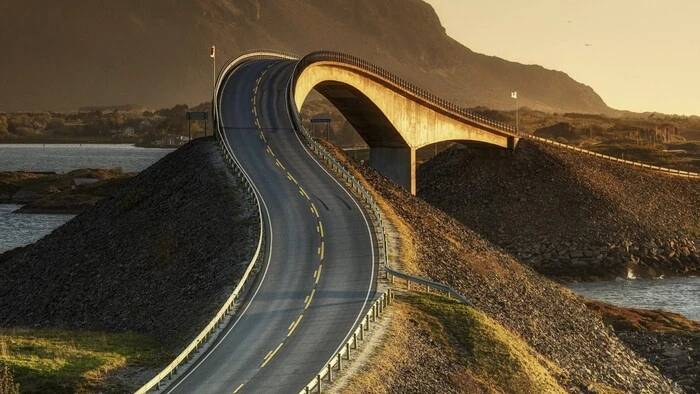
The Storseisundet Bridge is a striking cantilever bridge located on the Atlantic Road (Atlanterhavsveien) along Norway’s western coast in Møre og Romsdal county.
As the longest of the Atlantic Road’s eight bridges, it has become the roadway’s most iconic architectural landmark and a globally recognized example of daring bridge engineering.
From Møre og Romsdal’s coastal vantage points, the roadway’s 8% gradient and 21° convex arc merge with the Norwegian Sea horizon, spawning the viral optical illusion that the cantilever span free-falls into open ocean.
This disorienting visual effect has earned it vivid nicknames, including the “drunk bridge” and the “bridge that disappears.”
This visual cliff effect, amplified by winter hurricane swells crashing over the parapet, earned the 1989 structure the nicknames “disappearing bridge”, “drunk bridge”, and the Daily Mail’s 2011 headline “road to nowhere”.
Despite its heart-stopping appearance, the reinforced-concrete Storseisundet remains one of the world’s scariest-looking yet structurally sound coastal bridges, luring thrill-seeking drivers to Norway’s National Tourist Route 64.
18. Hanging Bridge of Ghasa, Nepal
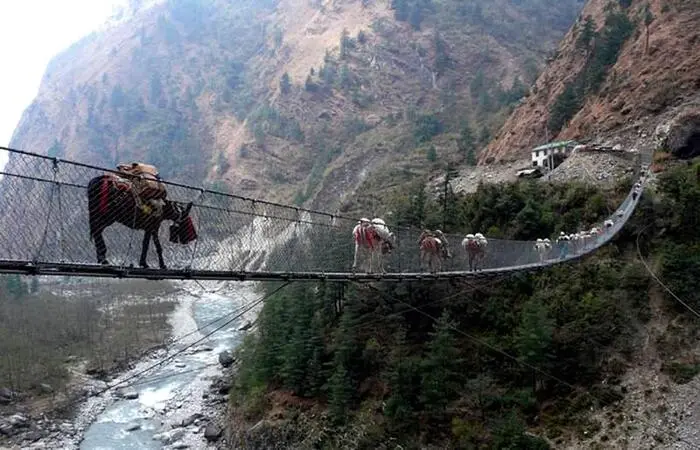
The Ghasa Suspension Bridge, situated near the village of Ghasa in Nepal’s Mustang District, is a pedestrian suspension bridge that spans a deep river gorge in the Himalayan region.
Known for its narrow design and its tendency to sway with the wind, the bridge has earned a reputation as both an intimidating crossing for outsiders and a critical lifeline for local communities.
The 1.2 m-wide deck, lattice sidewalls, and wind-induced lateral swing create a high-altitude adrenaline spike for trekkers on the Annapurna Circuit, yet Thakali herders steer yak and cattle caravans across the same span daily.
For many visitors, the oscillating motion of the bridge creates a sense of danger, reinforcing its place among the world’s most intimidating suspension bridges.
Yet, for the local population, the Ghasa Suspension Bridge is a trusted and reliable structure, routinely used with confidence by both people and animals.
This contrast between perceived danger and practical necessity makes it a unique and compelling example of the world’s dangerous yet indispensable bridges.
17. Musou Tsuribashi Bridge, Japan
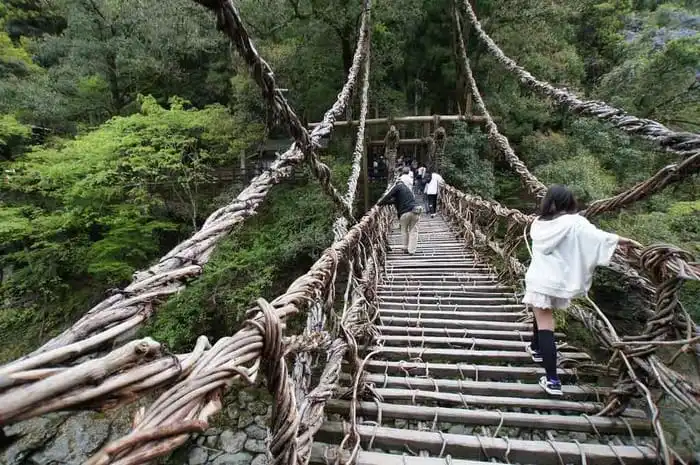
The Musou Tsuribashi Suspension Bridge, often referred to as “Japan’s Scariest Suspension Bridge,” is a narrow and precarious pedestrian footbridge hidden deep in the Southern Japanese Alps (Akaishi Mountains).
Built in the 1950s, it remains one of the oldest suspension bridges in Japan still in active use, and its reputation for danger has made it an infamous landmark among adventurous travelers.
The bridge is supported primarily by wire cables and features a wooden plank walkway that stretches across a steep and rugged mountain valley.
Its setting on the inclined slopes of the Akaishi Mountains makes access challenging reaching the bridge requires hikers to ascend a steep trail aided by metal chains, as the gradient is too dangerous to climb unaided.
Despite its intimidating appearance, the Musou Tsuribashi was originally constructed to serve isolated local communities in this remote mountain region, providing vital pedestrian connectivity where no roads could exist.
The bridge’s thin structure and tendency to sway in strong winds amplify its reputation as one of the most dangerous suspension bridges.
Yet, its enduring functionality for over half a century highlights the resilience of traditional Japanese suspension bridge engineering in challenging alpine environments.
16. Sidu River bridge, China
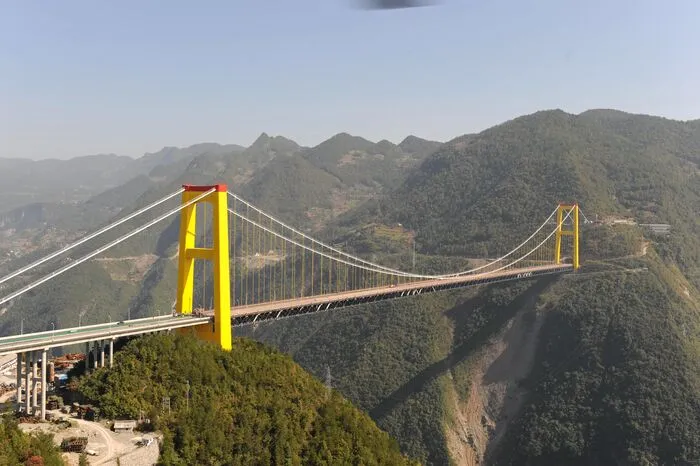
The Sidu River Bridge, located near Yesanguan in Badong County, is one of the highest and most visually intimidating suspension bridges in the world.
Opened in November 2009, it once held the title of the world’s highest bridge, with its deck rising 496 meters (1,627 feet) above the valley.
Spanning a deep gorge over the Sidu River, the bridge posed extreme construction challenges due to the steep and inaccessible terrain. Engineers solved this by using a rocket to carry the pilot cable across the gorge, a groundbreaking and rare engineering method.
The bridge features a steel suspension structure with concrete towers and a truss-stiffened deck. It stretches about 1,222 meters (4,009 feet) in total length, with a main span of 900 meters (2,952 feet). The project cost approximately $100 million, reflecting its scale and complexity.
Although it lost its height record in 2016 to the Duge Bridge, the Sidu River Bridge remains a remarkable engineering achievement.
Its extreme height, remote location, and dramatic setting make it one of the most breathtaking and dangerous-looking bridges in the world.
15. U Bein Bridge, Myanmar
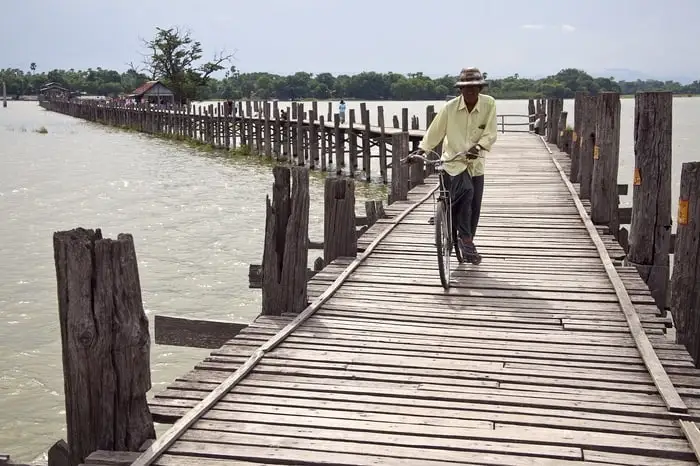
Located near Amarapura, the U Bein Bridge is the world’s oldest and longest teakwood bridge, built between 1849 and 1851 under U Bein.
It was constructed using reclaimed teak from the former royal palace of Inwa.
Stretching about 1.2 kilometers (0.75 miles) across Taungthaman Lake, the bridge stands on over 1,000 pillars, many of which have been reinforced or replaced with concrete.
Despite these upgrades, the lack of guardrails makes it a potentially hazardous crossing for pedestrians.
The bridge is renowned for its historic architecture and scenic beauty, especially during sunrise and sunset, attracting photographers and travelers worldwide.
It also serves as a vital daily route for monks, locals, and vendors.
However, decades of exposure to flooding, termites, and natural decay have weakened many of the original teak structures.
Some pillars are deteriorated or partially detached, increasing structural risk.
Ongoing preservation efforts by Myanmar’s cultural authorities aim to balance restoration with historical authenticity, as the bridge remains both a cultural landmark and a fragile, aging structure often listed among the world’s most dangerous bridges.
14. Eshima Ohashi Bridge, Japan
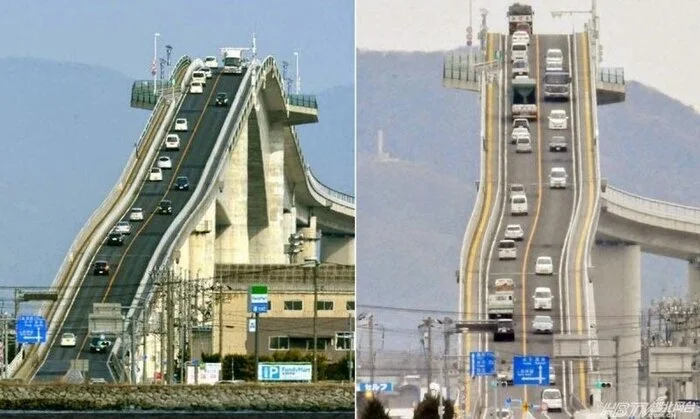
The Eshima Ohashi Bridge (Japan’s “Rollercoaster Bridge”) is a massive rigid-frame concrete bridge connecting Shimane Prefecture and Tottori Prefecture.
Stretching approximately 1.7 km (1.06 miles) and rising to 45 meters (148 feet), it allows large ships to pass beneath.
Its global fame comes from its steep gradients of about 6.1% on the Shimane side and 5.1% on the Tottori side.
When photographed with a telephoto lens, the bridge creates a dramatic optical illusion of a near-vertical climb, making it appear far more dangerous than it actually is.
Built between 1997 and 2004 to replace a bascule bridge and reduce traffic congestion, it is now the largest rigid-frame bridge in Japan and among the largest worldwide.
Despite its intimidating appearance, the slope is manageable for vehicles, though the visual effect continues to attract photographers and thrill-seeking visitors.
The Eshima Ohashi Bridge stands as both an engineering achievement and a visual spectacle, blending practical infrastructure with a reputation as one of the most striking “dangerous-looking” bridges in the world.
13. Kuandinsky Bridge in Kuanda, Russia
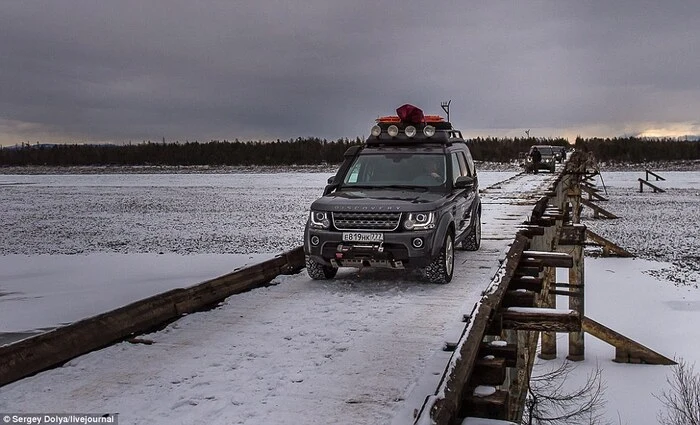
Kuandinsky Bridge, located in Russia’s Trans-Baikal Region, is one of the narrowest and most dangerous roads in Siberia, spanning the icy waters of the Vitim River.
Originally built as part of the unfinished Baikal–Amur Mainline, the bridge stretches 570 meters (1,870 feet) but is just over 2 meters (6 feet) wide, leaving almost no margin for error.
With no guardrails or safety barriers, even minor miscalculations can be catastrophic.
The structure consists of aging iron supports and wooden railway sleepers, many of which have deteriorated over time. During Siberia’s long winters, these planks become extremely slippery due to snow and ice, effectively turning the bridge into a hazardous surface.
Strong crosswinds further increase the danger, sometimes forcing drivers to roll down their windows to stabilize the vehicle while carefully navigating the narrow path.
Despite these extreme conditions, the bridge remains a critical lifeline for local residents. It has also gained global attention as a challenge for thrill-seekers, where crossing it is seen as a test of precision and nerve.
Snow, ice, and strong crosswinds intensify the danger, often forcing drivers to roll down their windows to reduce wind resistance while inching across this icy, cold, and dangerous place.
12. Puente de Ojuela, México
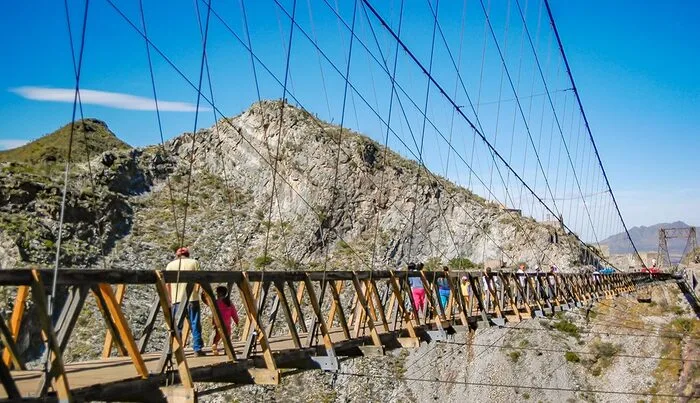
The Puente de Ojuela in Durango is one of the narrowest and most nerve-racking suspension bridges in the world.
Measuring just 0.6 meters (2 feet) wide, it stretches about 318 meters (1,043 feet) across a deep ravine and rises nearly 110 meters (360 feet) above the valley floor.
Built in 1898 by engineers linked to the Brooklyn Bridge design lineage, the bridge originally connected the ghost town of Ojuela to nearby gold and silver mines. At the time, it ranked among the longest suspension bridges of its era.
Today, reinforced with steel cables, it serves primarily as a tourist attraction. Its open framework, narrow walkway, and creaking wooden planks create an intense sense of exposure, offering uninterrupted views straight down into the ravine.
Surrounded by the ruins of the abandoned mining town, the Puente de Ojuela delivers a unique mix of historical significance and extreme visual danger, making it a must-visit for thrill-seekers and photographers alike.
11. Canopy Walk, Ghana
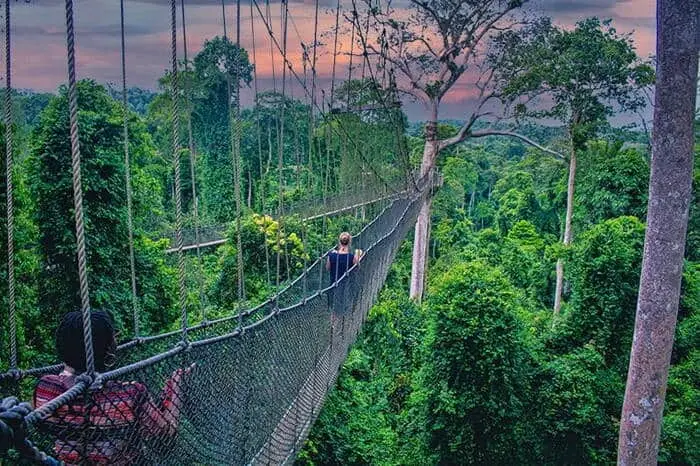
The Kakum Canopy Walk, located in Kakum National Park, offers a unique rainforest experience from about 40 meters (130 feet) above the forest floor.
It consists of seven suspension bridges connected between tall trees, spanning approximately 350 meters (1,150 feet) in total.
Built in the 1990s with collaboration between Canadian engineers and Ghanaian experts, the structure uses wire ropes, aluminum ladders, and wooden planks, with protective netting to enhance safety while preserving the natural environment.
The walkway provides close-up views of the forest canopy, including birds, monkeys, and diverse plant life.
However, due to its height and the natural swaying of the bridges, it can be challenging for those with a fear of heights.
As one of the few canopy walkways in Africa, it stands as a major ecotourism attraction, offering visitors a rare opportunity to explore rainforest ecosystems from an elevated perspective.
10. Suspension Bridge on the Trift Glacier, Switzerland
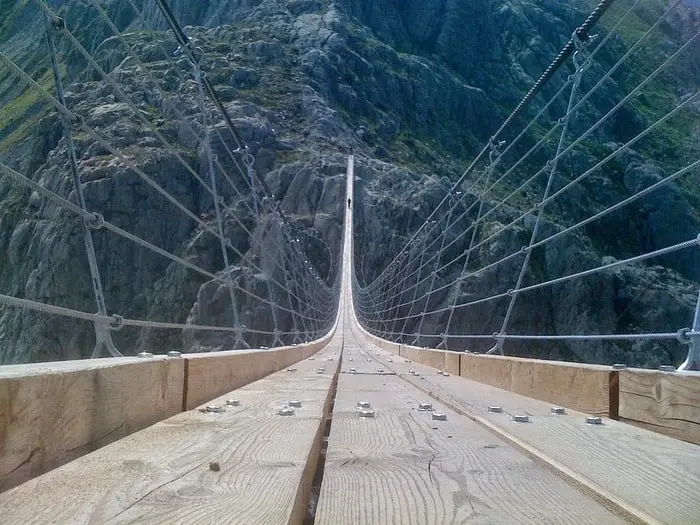
The Trift Bridge is one of the most spectacular pedestrian suspension bridges in the Swiss Alps. It spans 170 meters (558 feet) and hangs about 100 meters (328 feet) above Triftsee, a lake formed by meltwater from the retreating Trift Glacier.
The bridge offers breathtaking panoramic views of alpine cliffs, glacier landscapes, and turquoise waters, making it a major attraction for hikers and adventure seekers.
Reaching the bridge requires a cable car ride followed by a 90-minute uphill hike, which can be steep and physically demanding.
The journey itself adds to the overall experience, combining scenic beauty with physical challenge.
Due to its height and suspension design, the bridge can sway, requiring caution and proper safety awareness, especially in changing mountain weather conditions.
The current structure, completed in 2009, replaced an earlier, less stable version from 2004, improving safety while accommodating the growing number of visitors drawn to this dramatic alpine location.
9. Carrick-a-Rede Rope Bridge, Northern Ireland
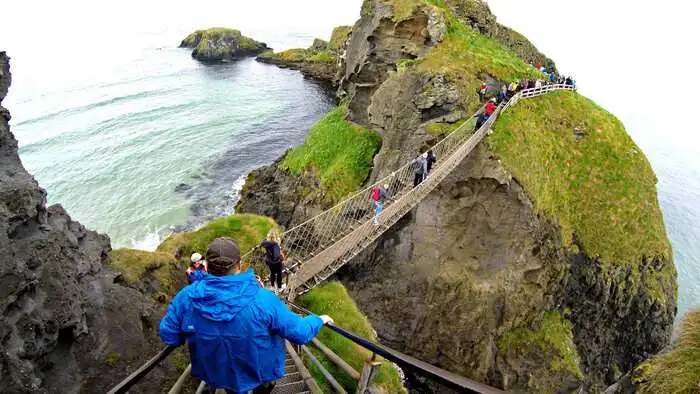
The Carrick-a-Rede Rope Bridge offers a dramatic and exposed crossing, suspended 30 meters above the sea and rocks, where its natural swaying can feel intimidating to visitors.
Despite its appearance, modern engineering upgrades and strict safety measures have made the bridge highly secure.
These include regular maintenance, controlled foot traffic, and closures during adverse weather conditions, significantly reducing actual risk.
While there have been no major accidents in recent years, the experience can still be psychologically challenging, particularly for those with a fear of heights or balance issues.
Visitors are advised to follow safety guidelines and walk carefully, as minor missteps could still lead to small injuries, even though the overall structure is considered safe.
8. Monkey Bridges, Vietnam
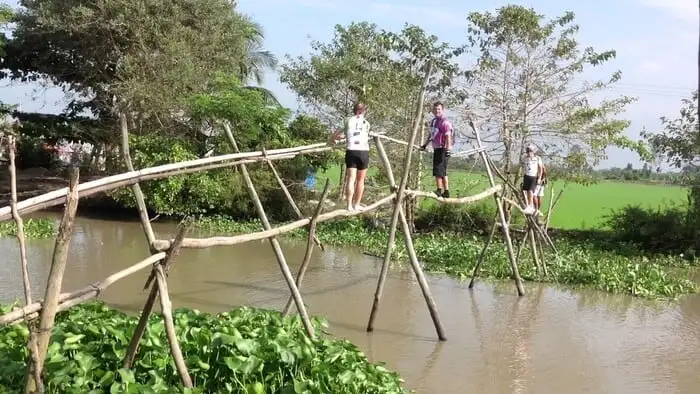
Monkey Bridges (locally called cầu khỉ) are traditional handmade footbridges found across rural Vietnam, especially in the Mekong Delta.
Typically built from a single bamboo log or narrow wooden plank, with minimal or no handrails, these bridges require balance, agility, and careful movement.
Their name comes from the crouched posture needed to cross (resembling a monkey), since even a small misstep can result in falling into the water below.
Constructed by local villagers using bamboo and wood, Monkey Bridges serve as essential links between villages, rice fields, and markets, particularly in remote areas.
Although many have been replaced by modern infrastructure, they remain important cultural symbols of rural Vietnamese life and ingenuity.
Known globally for their difficulty, Monkey Bridges are often ranked among the world’s scariest bridges, offering a crossing experience that is both intimidating and physically demanding, especially for first-time visitors.
7. Aiguille du Midi Bridge, French Alps
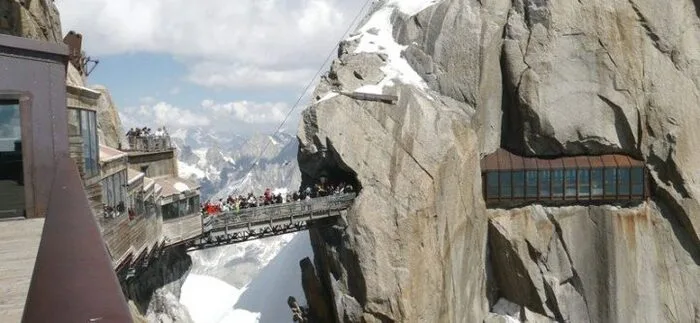
The Aiguille du Midi footbridge offers one of the most breathtaking high-altitude experiences in Europe, located at 3,777 meters (12,388 feet) in the Mont Blanc Massif within the French Alps.
Though relatively short, the bridge connects the summit station to a viewing platform, delivering panoramic views of Mont Blanc and surrounding peaks. Its extreme elevation creates a strong sense of exposure and vertigo for visitors.
Access to the site is via a two-stage cable car from Chamonix, rising from about 1,035 meters to 3,777 meters, one of the highest vertical ascents by cable car in the world.
The journey itself offers dramatic views of glaciers, cliffs, and alpine landscapes.
At the summit, crossing the footbridge becomes a thrilling yet manageable experience, combining safety with an intense visual drop. For visitors comfortable with heights, it provides one of the most spectacular viewpoints in the Alps.
6. Royal Gorge Bridge, USA
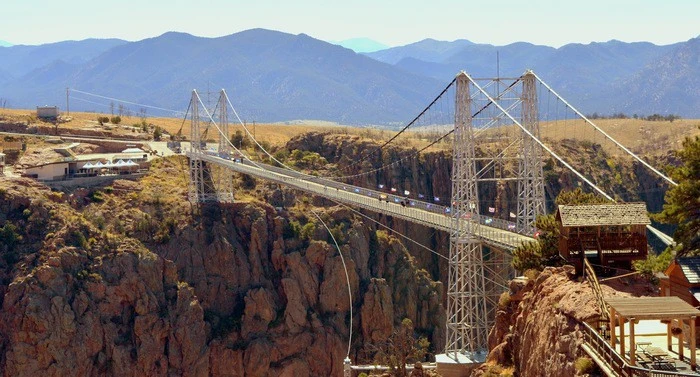
The Royal Gorge Bridge in the United States once held the title of the world’s highest suspension bridge until 2003.
Spanning the Arkansas River, it stands about 291 meters (956 feet) above the canyon floor, offering dramatic views and a strong sense of height.
That record was surpassed by the Beipan River Guanxing Highway Bridge in Guizhou Province, which rises approximately 366 meters (1,201 feet) above the Beipan River.
When it opened, it became the highest suspension bridge, highlighting China’s rapid advancement in high-altitude bridge engineering.
While the Guanxing Bridge serves as a key transportation link through mountainous terrain, the Royal Gorge Bridge has evolved into a major tourist attraction, featuring activities like zip lines, gondolas, and sky coaster rides that capitalize on its extreme height.
Although newer bridges have since surpassed both in height, each remains significant—the Royal Gorge Bridge for its historic record and tourism appeal, and the Guanxing Bridge for its role in modern infrastructure and engineering achievement.
5. Seven Mile Bridge, Florida
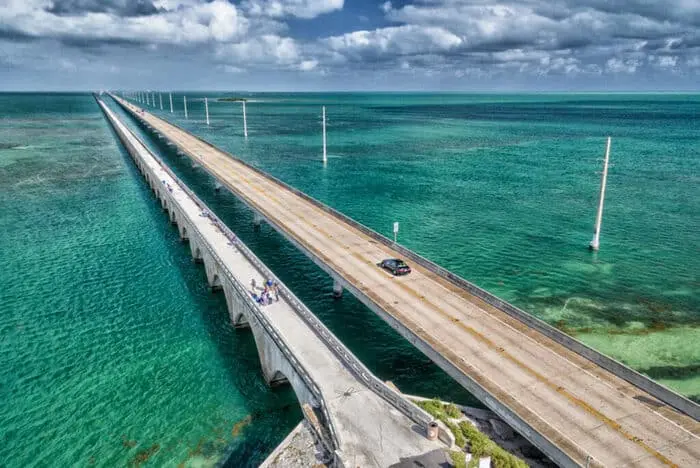
The Seven Mile Bridge is a famous landmark in the Florida Keys, stretching approximately 6.79 miles (10.93 km) across open ocean waters. It connects Knights Key in the Middle Keys to Little Duck Key in the Lower Keys.
The modern bridge, completed in 1982, is a two-lane causeway with sections rising about 65 feet (20 meters) to allow marine traffic to pass beneath.
It replaced an earlier bridge built as part of the Florida East Coast Railway, originally developed under Henry Flagler in the early 1900s.
Parts of the old bridge still exist, now used for fishing and pedestrian access, although many sections are closed due to deterioration from saltwater exposure and storm damage.
While generally safe under normal conditions, the bridge’s location makes it vulnerable to hurricanes, a recurring natural threat in the region.
Its scenic setting and engineering scale have also made it a popular feature in films and television, enhancing its cultural significance.
4. Capilano Suspension Bridge, Canada
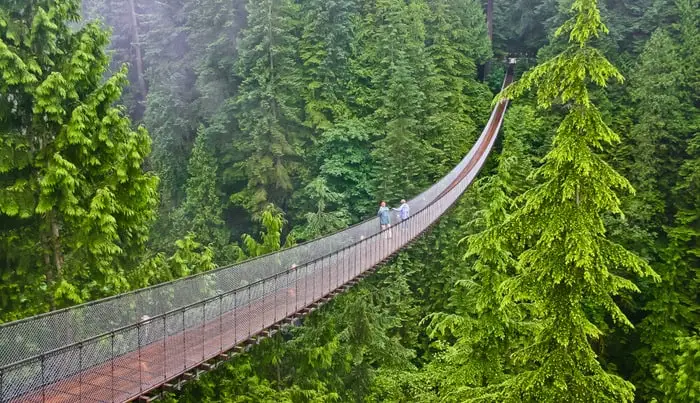
The Capilano Suspension Bridge is an iconic pedestrian attraction located in North Vancouver.
It spans 140 meters (460 feet) across the Capilano River and hangs about 70 meters (230 feet) above the canyon below.
Originally built in 1889, the bridge began as a simple structure made of hemp ropes and cedar planks, but it has since been upgraded with steel cables and modern materials to ensure safety and durability.
The bridge is part of a private park that attracts over 1.2 million visitors annually, featuring additional attractions such as treetop walkways and cliffside paths through a lush temperate rainforest.
Although the bridge sways noticeably (creating a thrilling and sometimes intimidating experience), it is well-maintained and structurally safe, with no significant fatalities reported.
Visitors with a fear of heights or vertigo may still find the crossing challenging due to its elevation and movement.
3. Langkawi Sky Bridge, Malaysia
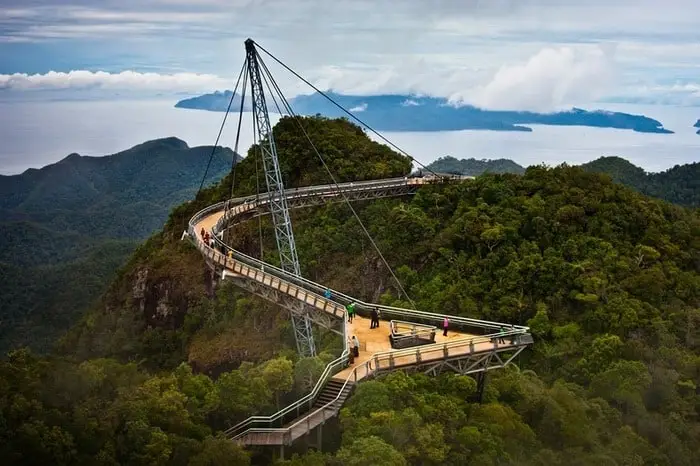
The Langkawi Sky Bridge is a curved pedestrian cable-stayed bridge located at 660 meters (2,170 feet) above sea level on Gunung Mat Cincang in Langkawi.
The bridge extends 125 meters (410 feet) and is suspended 100 meters (328 feet) above the ground, supported by a single 81.5-meter-high pylon.
Visitors reach the bridge via the Langkawi Cable Car, followed by the SkyGlide inclined lift, which connects the top station to the bridge.
The design offers panoramic views of the rainforest and nearby waterfalls, including Telaga Tujuh Waterfalls.
Constructed in 2004 and opened in 2005, the bridge was prefabricated and assembled on-site using helicopters, showcasing advanced engineering techniques.
It underwent major maintenance between 2012 and 2015 before reopening.
Despite its height and dramatic setting, the bridge is structurally safe, equipped with steel railings and wire mesh sides.
However, its elevation and slight movement can still feel intimidating, making it both a thrilling attraction and an engineering landmark.
2. Hussaini hanging Bridge, Pakistan
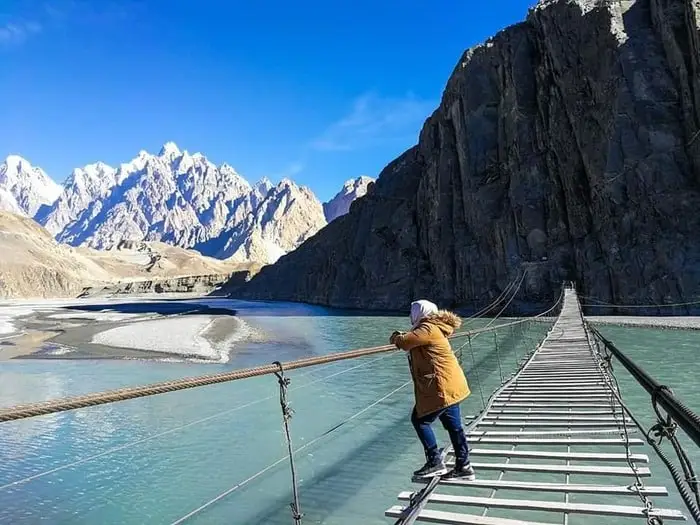
The Hussaini Hanging Bridge, located in Gilgit-Baltistan, is widely regarded as one of the most precarious rope bridges in the Himalayas.
It stretches 200 meters (660 feet) across the Hunza River, hanging about 15 meters (50 feet) above the fast-flowing water.
Constructed from widely spaced wooden planks supported by steel cables, the bridge features large gaps between steps, allowing clear views of the river below.
Combined with strong winds that frequently sway the structure, this creates a highly intimidating crossing experience.
Originally built around 1968 to connect the villages of Hussaini and Zarabad, the bridge has been rebuilt multiple times due to flood damage and wear. Remains of earlier structures still lie nearby, highlighting its fragile history.
Today, it serves both as a vital local crossing and a global adventure attraction, drawing thrill-seekers eager to test their nerves while enjoying views of the Karakoram Mountains and surrounding glaciers.
Although major accidents are rare, the bridge’s exposure and structural simplicity mean crossings carry real risk, requiring careful footing, balance, and strict attention to safety.
1. Deception Pass Bridge, Washington
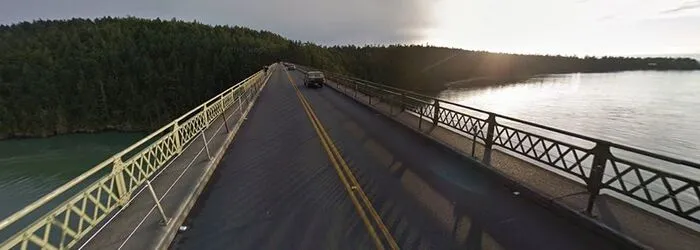
The Deception Pass Bridge, located in Deception Pass State Park, connects Whidbey Island to Fidalgo Island.
This two-lane steel cantilever bridge stands about 55 meters (180 feet) above the turbulent waters of Puget Sound and spans approximately 453 meters (1,487 feet).
Driving across the bridge can feel intimidating, especially during foggy conditions when visibility drops and the rushing water below becomes more dramatic.
The bridge also includes narrow pedestrian walkways, where the proximity to the edge heightens the sense of exposure.
Built in 1935, it is both a historic engineering landmark and a major tourist attraction, drawing millions of visitors each year.
Its combination of strong ocean currents, elevation, and confined walking space makes crossing the bridge a visually thrilling and slightly nerve-inducing experience, particularly for those sensitive to heights or motion.
The world’s most dangerous bridges remind us that travel isn’t always about comfort, it can also be about confronting fear and embracing adventure.
Whether it’s the historic Puente de Ojuela in Mexico, the swaying Trift Bridge in Switzerland, or the high-canopy walkways of Kakum National Park in Ghana, these structures symbolize resilience, ingenuity, and the human will to cross even the most treacherous landscapes.
For some, they remain vital routes of daily life; for others, they offer an unforgettable test of nerve. Each bridge is a stark reminder that danger and beauty often go hand in hand in the pursuit of connection.
Thanks